How to Choose the Right Book Format in 2026
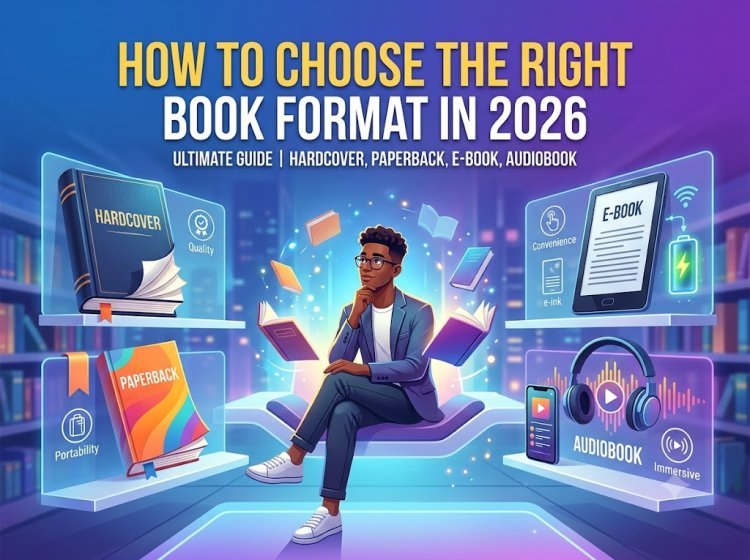
I used to buy every book I wanted as a hardcover, no second thought. Then I realised I was wasting money and not getting the full pleasure of reading. In the last few years I’ve tried just about every format out there – physical books, kindle, audiobooks, paperbacks. I’ve figured out what format works best for what application.
Here’s a practical guide to choosing the right book format in 2026, based on my own experience.
My Own Experience with Format
For a long time, I thought “real reading” was only physical books. I’d stopped reading long novels because they were too big, I ruined lots of books and I carried heavy hardcovers around on trips. Then I got a Kindle for a long commute, and my annual intake almost doubled. Then I found audiobooks to do chores, and for walking. Each format has its own ideal use.
1. Physical books
When choosing physical books:
I would like to collect or display the book, including special editions, gifts and my favourite authors.
Now I’m reading in a comfy chair at home and I’m interested in the tactile experience of it, the weight and smell and turning of the pages.
It’s a quick read or a book of poetry or art where visuals count.
My experience: Physical books are expensive, take up a lot of space and are not convenient to take with you when you travel. However they are a premium and satisfying experience. Now I limit myself to 8-10 physical books per year.
2. Kindle and Ebooks
When I choose the Kindle:
This device is lightweight and can be carried around with hundreds of books while travelling or commuting.
Reading at night (with built-in light, no disturbing partner).
(800-page books that are portable) Novels or series that are lengthy.
Wanting to select, and find text easily.
My experience: I have been reading at 2-3 times the speed since I switched to the Kindle for most of my fiction reading. The biggest shocker was how much I like to read in bed, without the need for a lamp. The only downside is that I miss the “shelf” of completed books.
3. Audio books
Selecting audiobooks:
Driving. Exercising. Walking or doing housework .
Biography or non-fiction (good for absorbing ideas while you do other things).
When my eyes are tired, I want to do more 'reading'.
My experience: Audiobooks were instrumental in maintaining my reading habit during a busy work year. I "read" over 25 books while walking my dog. The narration needs to be good, a good book can be ruined by a bad narrator. I currently use a combination of Libby (library app) and Audible.
4. Hybrid Approach (My Current System)
This is the best thing for me in 2026:
Fiction → Mostly Kindle, but the occasional physical copy of personal favourites.
Nonfiction audiobook, then Kindle for the highlights.
Special books (poetry, collectibles, gifts) are only available as hard copy.
My reading volume and enjoyment have both increased significantly because of my ability to switch formats based on context.
Now I have the following decision framework:
Before purchasing any book I ask:
When and where will I read it most?
Do I want to keep it forever?
Am I doing deep reading or am I multi-tasking?
What is the status of my storage and budget?
Final thoughts
There is no one “best” format. There is the best format for you, at any given moment. Try different things . Note what things make you read more , and enjoy more . Then make your own system .
It need not be tied to one format. We want to read more of the books we love.