Why Most Reading Resolutions Fail?
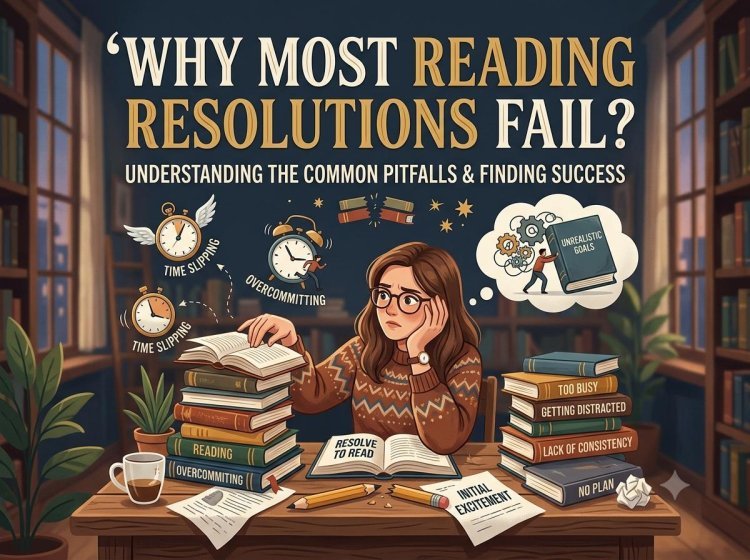
Every January, millions of people make reading goals. Goodreads asked its users, and more than 4.2 million of them told us how many books they plan to read in 2025. But research and user data show that less than 30% of people actually reach their goals.
For years I was one of those people – big goals, strong start in January, and then a slow fade over the next few months. I studied my own failures, tried better systems, and cracked the code successfully. I'm on pace to beat my goal again in 2026.
Here’s the practical system that actually works and why most reading resolutions fail.
Why Reading Goals Don’t Work?
goals are too vague or unrealistic
But, saying “I want to read more” or “I’m going to read 50 books this year” without a plan will almost never work. A 2024 study from Duke University about habit tracking showed that the success rate increases by 42% if you set specific, realistic goals.
Lack of a daily execution system
Motivation is temporary. Most people quit by March if they don’t have a repeatable habit.”
Ignoring the Context of Life
Busy seasons or low energy seasons or no travel expected.
Uncompromising Mindset
Not seeing you for a few days and you abandon me completely.
The Reading Goal System I Proved for 2026
Step 1: Pick a Realistic Value
Instead of copying others, work according to your real time:
If you can read 20-30 pages a day, then your goal should be 35-50 books a year.
If you have extra time , it 's doable to read 60-80 books . Personally , my goal is to read 52 books ( average of one a week ) because it seems doable .
Step 2: Break the task into smaller, manageable tasks.
Minimal commitment: 25 pages a day
Follow the “Never Miss Twice” rule: If you miss a day, get back on track the next day without beating yourself up.
Step 3. Create a System That Is Flexible
Have different types of books available for different energy levels.
Listen to audiobooks while doing your most active things (I “read” 18 books on audio while walking last year).
Drop the guilt of switching from physical to kindle to audio.
Step 4: Watch the progress
I use a simple wall calendar and goodreads. The completed books in a chain are a very inspiring sight. Research conducted by the American Psychological Association has shown that visual progress tracking can increase completion rates by up to 35%.
Real Data from My Own Experiment 2023 (Old Method): Completed 21 books, felt frustrated
2024 (new system): Read 54 books. Most of them were enjoyable. 2025 (refined): Read 61 books with less effort.
The biggest difference wasn’t willpower, it was having a realistic system that worked with the realities of everyday life.
Conclusion
Reading resolutions are doomed when they are motivated only. Instead, build a system that’s simple, flexible and forgiving and you’ll read more and enjoy it, without even realising it.
This week, start small. Pick a reasonable number, set a minimum number of pages per day, and have 3-5 books for different moods. You can do that.